Finding Calm

February 4th, 2010

Although there are many starting points for the path of inner transformation, most people nowadays find that their lives are hurried and filled with too much stimulation.  Because of this constant over-stimulation, most of us become over-sensitive and prone to letting things build up and then over-reacting to something relatively insignificant.  The media doesn’t help much, pulling on us like the force of gravity into feelings of insecurity and worry over the ever-escalating crises on the national and world stage.

Closer to home, we seem dogged forever by the repercussions of past mistakes even as we worry about the mistakes our loved ones might be making right now.  Like others we know, we find ourselves confused about the direction our important relationships have taken and worried that being so over-whelmed is making it difficult to let ourselves really be touched by others.  We can sense that we feel close to the breaking point too often, yet we never seem to have the time or energy for the spiritual pursuits we know would help us cope with all the stresses of everyday life.  Instead of finding the bottom of our dissatisfaction, we try to muddle through, alternating between impatience and procrastination, between being explosive and being apathetic, between over-reacting and ignoring.  All in all, most of us take up the path of inner transformation feeling much too serious and not nearly light-hearted enough.

The progress that modern technology brings to human life is the result of a collective and sustained effort to keep our attention focused on the workings of the external world.  This goes a long way to making possible our sense of material well-being, but it also contributes to our unfamiliarity with the workings of the inner world.  For example, few people are aware that most of what they experience internally are simply the habits of thought, emotion, and memory that they have accrued over the course of their lives.  What most of us think of as me, in other words, is the sequence in which certain long-ingrained ideas and feelings and memories are triggered and relived, over and over.

Even the present is experienced through the filter of these habits that we mistake for our real identity—rather than functioning as creative beings, we tend to wander around, reacting in ever more predictable ways to the things we bump into in life.  And no matter how often our reactions prove self-defeating, still we persist in responding to whatever we encounter in the same automatic ways.  All in all, most of us take up the path of inner transformation acting as if we were incapable of changing ourselves.

But if habits can be started, they can be ended.  If they can be kindled, they can be extinguished.  If they can grow obsolete and no longer adaptable, they can be replaced with new and more adaptable ones.  And just as our old habits acquired strength through repetition, the new ones we create gain strength through the repetition of inner training.

So until the body, emotions, and thoughts can be calmed by inner training, they carry us away like a wild horse plunging across an endless field—and just as musicians and athletes train to achieve peak performance, we all need to train our instincts, feelings, and self-talk if we are to reach our full potential.

Let us begin by asking ourselves a straightforward question:  How does a capable and confident person my age act under pressure?

And let us begin by building up an image of ourselves acting thus.

Untitled1

This is the I Ching trigram for Mountain.  It represents Stillness and Stability.  Like the eye of a hurricane, it is the Still Point around which all change turns.  By sensing the immovable Mountain within, we train ourselves to achieve inner Calm.

If you need to alter your outer circumstances before starting your inner training, there are several time-proven guidelines you may find helpful.

  • Slow your life down.
  • Establish a list of priorities that reflects your true values.
  • Disentangle yourself from the lower priorities.
  • Spend more time enjoying the higher priorities.
  • Stop talking about your problems until you are sure you know what they really are.
  • Listen more to those who are important to you.

~

Next week, Part Two of Finding Calm.

The above is an excerpt from The Spiritual Basis of Good Fortune by William Douglas Horden.

If you’d like to learn more, visit the website:  http://spiritualbasisofgoodfortune.com/

~

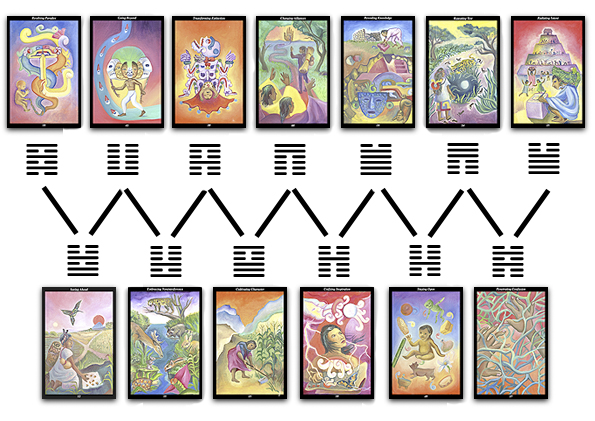
The Toltec I Ching, by Martha Ramirez-Oropeza and William Douglas Horden has just been released by Larson Publications.  It recasts the I Ching in the symbology of the Native Americans of ancient Mexico and includes original illustrations interpreting each of the hexagrams.  Its subtitle, 64 Keys to Inspired Action in the New World hints at its focus on the ethics of the emerging world culture.

Click here to go to the main site to see sample chapters, reviews and the link to Larson Publications for ordering the book.

The Tao of Axolotl

January 12th, 2010

At the end of the last Age, the gods gathered at Teotihuacan to create this Age that we live in now.  It became clear that a great sacrifice would be needed to start the world over, and so they agreed that they would all, without exception, leap in to a giant bonfire so that their deaths could begin this, the Fifth Sun.  And although they all agreed, the god of twins, Xolotl, did not wish to sacrifice himself and so he fled and hid, transforming himself into a two-stalked maguey plant.  But the other gods knew the sacrifice would not work unless they all leaped into the fire, so they chased Xolotl and recognized him as the maguey.  Before they could catch him, though, Xolotl ran away again and hid, transforming himself into a two-stalked corn plant.  Again, the gods chased him and recognized him.  This third time, Xolotl ran and jumped into the water, transforming himself into the axolotl.  Now the other gods caught up with him and took him back to the bonfire, completing the self-sacrifice that made this world possible.

The axolotl is the larval form of the tiger salamander, native to two lakes in the Central Mexican Plateau.  It is famous as one of the highest lifeforms to exhibit the biological trait called neoteny, which refers to the ability of certain species to retain all their juvenile characteristics and reach sexual maturity despite never metamorphosing.  In the case of the axolotl, this means that it never drops it gills to leave the water and live on land like the adult salamander—instead, it lives its whole life in its immature phase, yet displaying the adult characteristic of sexual reproduction.

The word axolotl is a Nahuatl word constructed of two morphemes:  a-xolotl, from atl (water) and xolotl (the god of twins).

From all this we can say that the axolotl is a symbol of great creative power and independent action—a symbol of a being that integrates the positive characteristics of childhood and adulthood by not taking on the negative characteristics of adulthood.  It can produce the next generation without having to transform into the previous generation.  It is the symbol of the Ancient Child.

Its symbolic meaning correlates well with Hexagram 49, Staying Open, of The Toltec I Ching—

49 copy

Image:  An infant beholds the many diverse items in its surroundings, each of which is calling to the child.  The speech glyphs representing each article’s voice are of different colors in order to show that the child’s natural curiosity leads it to be fascinated by a wide array of interests.

Interpretation:  This hexagram depicts the openness of heart and mind and spirit of those who are adapting to the future.  The infant symbolizes the living potential dwelling within every individual.  The diverse objects around the child represent all the possible paths, both external and internal, lying before every individual at every turn.  That the infant’s attention is drawn to each of the interests means that you look at everything as an opportunity to develop yourself further.  Taken together, these symbols mean that you are not adapted to one particular environment but, rather, to any environment.

The Way of Axolotl is the path of the generalist.  It is the path of retaining the child’s sense of wonder and curiosity throughout a lifetime.  It is the tao of the breaking wave, the path of those who keep moving forward with change rather than settling into one particular vocation, lifestyle, or identity.  It is, in this sense, the path of paths:  it does not strive to reach some arbitrary goal but, rather, seeks to explore all the interesting paths it can find.  To the extent that it encourages specialization in us, it is always in the sense of the wayfarer who stops for a while to become intimately familiar with a particularly intriguing area before moving on to the next.

Intent:  The ideal society is just like the ideal family, existing to afford every member the opportunity to develop their full potential:  in times of darkness, on the other hand, authoritarianism restricts the creation of new opportunities and channels people into meaningless activities that benefit only those in authority.  Likewise, societies change just like families, transforming their goals and relationships with the passing of each generation:  whereas those who thrive in times of darkness cannot conceive a time of light, those who thrive in times of light can all too readily envision a return to darkness.  Whether it is the individual, family, society, or humanity as a whole, the cycles of the pendulum’s swings between the closing down and opening up of meaningful opportunities establishes the fundamental circumstances against which all actions take place and all decisions are made.  The best way to contribute to the lives of others is to nurture and encourage their efforts to further develop their own potential.  In this way, you materially assist others and help transform the fundamental circumstances within which all live.

Fortune favors those who are adapted ahead of time.  The Way of Axolotl goes against the current of culture and family, which generally seeks to channel people into pigeonholes where their lives become highly routinized, seeking instead to keep open the individual’s possibilities to realize his or her potential.  Rather than seeking to merely cobble people together in a haphazard way to make society limp along without real meaning, the Way of Axolotl seeks to create a meaningful society by affording individuals the opportunity to create meaningful lives for themselves.  The fact that cultures differ so wildly from one continent to another means that no culture is inevitable or unchangeable.

Summary:  Cultivate as wide a range of interests and relationships as possible.  Avoid the tendency to focus on one specific thing or person at this time.  Cultivate breadth, not depth.  It is a time of exploration, so follow your curiosity.  Do not jump at the first opportunity or commit yourself to a single course of action now.  Keep all your options open while you prepare for future opportunities.

The Tao of Axolotl is based on the symbol of the Ancient Child.  The fact that the axolotl retains its gills and does not leave the water like the adult salamander symbolizes the experience of those who retain the open-hearted and open-minded spirit of childhood, refusing to metamorphose into the unnatural state of critical, cynical, and domesticated adults.  The fact that the axolotl reaches sexual maturity and can produce offspring symbolizes the experience of those who are creatively productive, fashioning new norms and new opportunities for others simply by pursuing their own sense of wonder.

~

The Toltec I Ching, by Martha Ramirez-Oropeza and William Douglas Horden has just been released by Larson Publications.  It recasts the I Ching in the symbology of the Native Americans of ancient Mexico and includes original illustrations interpreting each of the hexagrams.  Its subtitle, 64 Keys to Inspired Action in the New World hints at its focus on the ethics of the emerging world culture.

The World Psyche

January 5th, 2010

The word psyche means both soul and butterfly.

The concept of a world soul arose among ancient philosophers and endures in the heart-mind of many modern people. It was expounded by Plato for one, and can be found in many other belief systems throughout history, up to the present where it appears as the Gaia principle.

Therefore, we may consequently state that: this world is indeed a living being endowed with a soul and intelligence … a single visible living entity containing all other living entities, which by their nature are all related.  —Plato

In this sense, the physical world is perceived to have a soul or spirit no less than we human beings have.  In the same way, moreover, that “the world” is actually all the things within it, including human beings, “the world soul” is actually all the individual souls within it, including human beings.  But where does this concept come from—and what does it have to do with a world butterfly?

As to the first point:  The world soul does not originate as a thought but, rather, as a sensation.  It is the inevitable result of nature mysticism, of lives so thoroughly immersed in the natural world that they can sense the one soul of which they are a part and experience their unity with it consciously.  This unifying experience of the underlying reality is what gives rise to the spiritual perceptions and practices known as animism and shamanism.

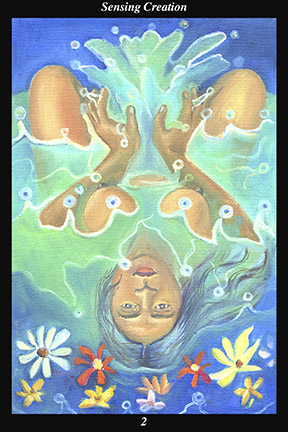
In The Toltec I Ching, Martha Ramirez-Oropeza and I make the point that people differ only in the degree of their sensitivity to the one soul.  Here is an excerpt from Hexagram 2, Sensing Creation

02 copy

Image:  A female warrior is naked, immersed in water and surrounded by flowers.  A wellspring of water rises from between her hands.  The water drops are drawn as beads of jade in order to portray the precious nature of that which sustains life.

Interpretation:  This hexagram represents the great courage essential to creating a meaningful life.  The female warrior symbolizes the way of nurturing and encouraging human nature that increases its sensitivity and loving-kindness.  Being naked means that nothing stands between you and the world.  Being immersed in water means that you plunge whole-heartedly into the spirit of that which nurtures all.  Being surrounded by flowers means that you perceive the perfection of the world as it truly is:  each moment blossoms perfect and whole, then passes like a fading flower—each perfection born into the world must die.  The wellspring of water symbolizes the inexhaustible source of courage that allows you to use your awareness of mortality to more profoundly experience the joy and sorrow inherent within every encounter.  In this sense, the flowers and the water signify not only the wisdom attained through experience, but the aesthetic sensibilities to be moved by a beauty and truth not always apparent to others.  Taken together, these symbols mean that you open your spirit to the overwhelming perfection of the world and share your vision with all you touch.

Keeping in mind that every individual is a spirit warrior with a feminine and masculine half, the formula for increasing our sensitivity to the unseen world soul can be phrased like this:  The feminine half of the spirit warrior collects the movement and energy of the unseen forces, calming them and bringing them together in harmony, making a place for them to gather strength and then making that source of benefit open and available to all.

This calming of the spirit in order to make a place, much like a womb, for the world soul to gestate in stillness and then be born in acts of benefit is an age-old formula by which men and women across cultures have attained states of profound bliss and meaningful success.

As to the second point:  The world psyche, like the individual human psyche, grows and evolves without limit.  Its only constant is one of change, always seeking further refinement and a higher order of universal benevolence.  Its only unchanging law is that of unending metamorphosis—what better symbol of our collective spiritual metamorphosis than the world butterfly?

~

The Toltec I Ching, by Martha Ramirez-Oropeza and William Douglas Horden has just been released by Larson Publications.  It recasts the I Ching in the symbology of the Native Americans of ancient Mexico and includes original illustrations interpreting each of the hexagrams.  Its subtitle, 64 Keys to Inspired Action in the New World hints at its focus on the ethics of the emerging world culture.

Lessons From The Toltec I Ching

December 21st, 2009

I am part of a Living Whole that wants the best for me and all others at the same time.

Inspired action flows spontaneously from an inspired mind.

When we replace trivial and undignified thoughts with substantial and ennobling ones, we are focused ahead of time on perceiving and interpreting events in the best possible light.  In this way, we take the energy we previously devoted to the pursuit of self-interest and channel it into acts that benefit all.

I am part of a Living Whole that wants the best for me and all others at the same time.

An inspired mind flows spontaneously from an inspired heart.

When we replace selfish and self-important feelings with generous and all-embracing ones, we are positioning ourselves ahead of time to respond to events with loving-kindness and goodwill toward all.  In this way, we take the energy we previously devoted to self-defeating attitudes and channel it into creative acts that benefit all.

I am part of a Living Whole that wants the best for me and all others at the same time.

An inspired heart flows spontaneously from being attuned to this single wish of the Living Whole:  that all benefit as one.

But how are we to give up our separate sense of self-importance and open our heart to this living wish when so many around us are acting out of greed, superstition and fear?  How are we to refine our thoughts and emotions when we are bombarded from every quarter with ever more sophisticated attempts to capture our attention?

It is one of the oldest lessons:  If your intention is clear of ulterior motives, then even distractions and confusion are The Way.

Self-defeating thoughts and emotions, from this point of view, are viewed as the enemy-within, the constellation of habit attitudes and habit behaviors that constantly throw up stumbling blocks to the spirit warrior’s progress.  Indeed, the spirit warrior is best defined as a woman or man who clarifies their intention by consciously training to (1) recognize Spirit within all matter and, (2) defeat the self-defeating habits of the enemy-within.

Freeing our intention of ulterior motives by focusing on these two goals, we find that confronting the distractions and confusion thrown up by the enemy-within becomes more like practicing with a sparring partner than an out-and-out battle.  More and more, the enemy-within is experienced as an artificial sense of self that was formed by the conditioning it received from family and culture.  As we get to know it better, it seems most like a recurring dream opponent trying to awaken us to our true potential.

For example, even if we were born to the same parents on the same day, it is obvious that were we then raised in a completely different culture, say the Mbuti of central Africa or the Inuit of the Arctic tundra, we would have a completely different personality, a completely different sense of self in relationship to the world-at-large.  Once the hollowness of this illusory, conditioned, self is fully experienced—like recognizing that the distorted image in a funhouse mirror is not our true reflection—we stop reacting automatically to events around us.  Our actions become more creative, more spontaneous, and meet with greater success.

In this sense, inspired action, an inspired mind, an inspired heart, and attunement to the wish of the Living Whole all spring from living each moment with an intention free of ulterior motives.

I am part of a Living Whole that wants the best for me and all others at the same time.

Spirit, like nature, abhors a vacuum.

When we clear our intention of ulterior motives, we are no longer beleaguered by our inner talk—Spirit rushes in to fill the clearing we have made for it.  Our heart-mind becomes its nest.

And of what is this nest constructed?

Lessons:  the accrued wisdom of the ancients, who first learned to stop their inner talk and then recorded what Spirit whispered to them in that shining silence.

By taking Spirit’s voice to heart, we, like the ancients, replace unworthy and self-destructive thoughts and emotions with ennobling and beneficial ones.

An Oracle is the voice of Spirit, speaking to us across the ages in the language of lessons.

Lessons are wisdom teachings, a body of ethical principles that can be adapted to the ever-changing circumstances of life.  As in sailing, you don’t set your sails to go with the wind in the same way you do to tack against the wind—nor do you drop anchor in the open sea just because it works when you are in port.  Lessons and their ethics guide our responses to change. Lessons make us better adapted to events, more competent, more improvisational, less predictable, and more creative.  Their ethics make us more generous, more compassionate, less competitive, more collaborative, and more successful.

The Toltec I Ching incorporates the lessons and ethics of the Oracles of two of the world’s great civilizations.  From ancient Mesoamerica, comes the Oracle of the Tonalpoalli, or Sacred Calendar, with its lessons inspired by the great civilizing spirit of the Toltec sages.  From ancient China, comes the Oracle of the I Ching, or Book of Change, with its lessons inspired by the great civilizing spirit of the Taoist sages.  We invite you to explore further your own inner path—and to carry the timeless wisdom of the ancients back into these troubled times.

This article appeared originally in Volume 8, Number 4 of Evolve! magazine.

The Toltec I Ching, by Martha Ramirez-Oropeza and William Douglas Horden has just been released by Larson Publications.  It recasts the I Ching in the symbology of the Native Americans of ancient Mexico and includes original illustrations interpreting each of the hexagrams.  Its subtitle, 64 Keys to Inspired Action in the New World hints at its focus on the ethics of the emerging world culture.

The questions we face today are no different than those faced by our predecessors:  How do I live authentically?  How do I achieve peace of mind without turning my back on those in need?  How do I attune myself to the world around me?

For the ancient Toltecs and the civilizations they inspired, the highest expression of their lifeway was embodied in the mystical philosophy of Flower-and-Song.

Flower-and-Song is a difrasismo, a common form of expression in the Nahuatl language that uses two words to form a metaphor for a third, more expansive, concept.  It is often translated as “poetry” but its meaning is more comprehensive than that, indicating that its practitioners strive to live a “poetic life”.  Examining the difrasismo a little makes this clear.

Flower in this context involves a three-stage engagement with the world.  The first stage involves seeing each moment—and whatever that moment holds—as perfect as a blossoming flower.  The second stage involves seeing each moment—and whatever that moment holds—as already fading and passing into death.  The final stage involves bearing these two visions simultaneously in the heart, engaging the moment and what it holds with the full emotional realization that it is perfect and dying.

Far from an intellectual exercise, this practice demands the greatest courage, for to face these two soul-shattering emotions at the same time requires us to open ourselves to the profoundest joy and grief all at once.  Without flinching from the perfection before us, we are filled with awe at the impossibility of spirit taking form in matter.  Without flinching from the inevitable death of everything we know and love, we cannot help but burst apart with grief and empathy.

This is a lifeway, in other words, of spirit warriors, those who exert constant effort to defeat their self-defeating attitudes and behaviors.  It is the lifeway of those who use death to awaken authentic gratitude for being alive and sharing this shape-shifting perfection with others.  When we experience it fully, Flower evokes a kind of spiritual nostalgia for the present moment that ennobles us and all our lives touch.

Song in this context means that the most authentic act we can perform is to give expression to the dual realization attained in Flower.  This is the reason that the difrasismo is generally translated as “poetry”.  But the deeper implication of this mystical philosophy of life means that Song involves treating every moment as an opportunity to express the truth of Flower.  It involves treating this entire lifetime as a single act of expressing the continuous vision of Flower.  It means using every thought, word and deed to embody the lifeway of Flower-and-Song.

Treating all things as miracles that pass away too soon, our thoughts, speech and actions take on a new caliber and timbre.  We concentrate on what is present instead of what is absent and we discover new depths of patience and tolerance.  Our lives take on greater meaning and our contributions meet with greater success.  We treat everything and everyone more nobly and we are enriched immeasurably.

As a spiritual practice, Flower-and-Song enters each moment asking two questions:  What is in front of me?  How am I treating it?

What is in front of me? opens us to the ultimately unknowable nature of the world.  By questioning the absolute nature of our perceptions, we come to accept the extraordinary mystery everywhere veiled by ordinary appearances.  It is a question that, once taken seriously, forces to us to look closer at the world:  Is this merely what I have become accustomed to seeing through daily contact—or is it the sea of spirit in all its manifest forms?

How am I treating what is in front of me? demands that we watch our inner actions—our thoughts and intentions, our wishes aimed at things outside ourselves—as well as our outer demeanor and reactions.  Am I acting nobly or mean-spiritedly?  Am I ennobling my life or trivializing it?  Am I rising above pettiness or descending into it?  Am I treating others like superiors and inferiors, all in pursuit of my self-interest—or as peers bravely facing their own death as well as they can?  Am I spreading ill will, discord and sorrow wherever I go—or compassion, collaboration and joy?

In our book, The Toltec I Ching, Martha Ramirez-Oropeza and I discuss the deeper implications of such a spiritual practice—

…..the spirit warrior breaks through the barrier separating matter and spirit.  Such a barrier is erected in our minds by the constant training we receive from those who find advantage in promoting the separation of people from nature, from each other, and from their own true self.  If people everywhere perceived matter and spirit to be the same thing, after all, the ignorance, cruelty, and suffering that make up much of human history would end.  If we were all to experience the material form of nature as spirit, we would stop harming it by diminishing it faster than we help it replenish itself.  If we were all to experience the material form of people everywhere as spirit, we would stop harming one another by acting as if our own rights and desires were superior to their own.  If we were all to experience the material form of our own individual bodies as spirit, we would stop harming ourselves by doubting that every thought, feeling, and action plays a pivotal role in eternity.  Breaking through such a mental barrier is a matter of constant training, as well.  If we do not use every thought, feeling, and action to intensify our experience of matter as spirit, we continue to desecrate the temple of nature, the temple of civilization, and the temple of individuality.

Those following the lifeway of Flower-and-Song find that it reveals the wellspring of rejoicing forever bubbling just beneath the surface of appearances.  It engages the world as a vast mystery of unimaginable potentials and aims to participate in its ongoing creation in ways that benefit the most.  It is not so much something we do on our own as much as it is music we hear and feel and long to play, a dance we cannot wait to join.  It arises from our depths to transform the ordinary into the extraordinary.

Holding to such a practice for extended periods of time has certain foreseeable consequences.  By forcing us to focus complete attention on appreciating the perfection of everything as well as mourning its inevitable passing, it trains us to attend fully to the moment, drop off inner talk, participate in life authentically, and honor everything as an equal knowing it must die.

But it has certain unforeseeable consequences, as well.  By blurring the imaginary boundary between self and world, it opens new senses and allows us to perceive the spirit within all matter.  By blurring the imaginary line between flawed and flawless, it opens our hearts to the sacredness of all form.  By blurring the imaginary boundary between animate and inanimate, it opens our eyes to the formless awareness forever transcending the very form it inhabits.  By blurring the imaginary line between time and space, it opens our minds to the unchanging presence through which all changing forms move.

The Lifeway of Flower-and-Song, then, is a spiritual practice of Inner Activism—it sensitizes us to our tendencies toward self-interest and alienation, replacing self-defeating habits with those of spontaneity, creativity, and good will.  It shifts our focus away from personal success toward a heartfelt longing for peace and prospering for all.

And it constantly reminds us that the Golden Age of Humanity is within our reach if we but dare hold out our hand.

.

The Toltec I Ching, by Martha Ramirez-Oropeza and William Douglas Horden has just been released by Larson Publications.  It recasts the I Ching in the symbology of the Native Americans of ancient Mexico and includes original illustrations interpreting each of the hexagrams.  Its subtitle, 64 Keys to Inspired Action in the New World hints at its focus on the ethics of the emerging world culture.

The great Chinese sage Chuang Tzu calls our attention to a strange tree beside the road.  Its bark is so tough that no ax can penetrate it, its wood is so twisted that it cannot be split or used for carpentry.  We can imagine this ancient tree, growing in the most dramatic and inspiring way, its leaves no good for tea, its fruit no good for medicine.  Of what value is this Useless Tree?

As Chuang Tzu points out, perhaps we ought to simply seek out its shade and be grateful for a place to rest or even admire the uniqueness of its form and beauty—perhaps we ought, in other words, to seek its true usefulness instead of pressing our own wants on it.

He goes further, however, to point out that the tree is ancient—and indeed, will continue to go on as it is—precisely because it cannot be exploited.  It remains true to its nature, so its life is not cut short by the whims of others.  Because it cannot be exploited, it lives on to fulfill its destiny of inspiring all who value the sublimely useless.

Objects of inspiration capture our attention because they defy our attempts to categorize them or domesticate them or explain them away.  They are troublesome in the sense that they speak to an older part of us, one that longs for symbolic communication, authenticating our own symbolic self.  And they can be particularly troublesome when their symbolic utterances precede actual events, as if there exists an underlying order to the world that synchronizes its happenings in a way that is completely invisible to our human senses.

Like the Useless Tree, they root alongside the road, offering us a place to rest and seek inspiration but oblivious to all who pass oblivious to their antiquity.  Such objects of inspiration are sublimely useless, beyond the exploitation of our own wants, precisely because they themselves are inspired.  Emerging out of the mists of prehistory, like great pyramids suddenly revealed by evaporating fog, they speak the language of our common ancestors.  They speak the language of our common soul.

The I Ching of ancient China is one such monument.  The Mayan Calendar of ancient Mesoamerica is another.  Both are divinatory systems that have survived now for more than three thousand years.  Both will still be standing, offering respite and inspiration, three thousand years from now.  They will outlive us as they have outlived all those other generations.

Troublesome indeed.  They beg so many questions.  Like the great pyramids, we wonder at how they were built in the first place, who conceived of their form and symmetry, what was the original source of their own inspiration.  But unlike pyramids that are built stone-by-stone, the I Ching had to emerge full-blown as a flower blooming overnight—what mind grasped the whole of its system all at once?  And unlike pyramids that are built stone-by-stone, the Sacred Calendar had to emerge full-blown as a flower blooming overnight—what mind grasped the whole of its system all at once?  Troublesome indeed.

Particularly now.  Because it is now that the Mayan Calendar completes its 5,128-year cycle.

On December 21st, 2012, the Winter Solstice, the Long Count of the ancient Mayans will arrive at the last day of its journey through the 13 Baktuns that comprise the Grand Cycle of 1,872,000 days.  Yes, that is correct:  the Mayan Calendar, originating among some of the world’s greatest astronomers and mathematicians of antiquity, comes to an end after nearly two million days, precisely on the Winter Solstice of 2012.

Troublesome indeed.  What are we to make of this strange coincidence?  Certainly it has now become a cultural meme of the first magnitude, propagated by an apocalyptic movie, dozens of knowledgeable books, and thousands of concerned websites.  The noise, for those tuning into the conversation, is an escalating crescendo of mixed messages and contradictory predictions.

What are we to make of this strange coincidence?  Here we are, alive at the time that the Mayan Calendar completes its Grand Cycle.  The stirring of voices around us grows louder with warnings, alarm, and scientific debunkings.  The media has jumped into the fray with both feet now and its ratings-driven programming requires as sensational an approach as possible.

I have written elsewhere in these blog postings about the actual mechanics and meanings of the Sacred Calendar, as well as the tendencies of groups to move unconsciously as a herd, so I am not going to cover that ground again here.  At the suggestion of Paul Cash of Larson Publications, I have consulted the Oracle of The Toltec I Ching regarding the meaning of this strange coincidence and what changes this 2012 cultural meme augurs.

With all this in mind, I cast the Oracle on November 14, 2009, and received an answer of Hexagram #5, Restoring Wholeness.  The result contained no line changes, indicating a relatively lengthy period—at least two years long—of similar change.  In other words, there may be fluctuations in the degree of change but not in kind.  The clearest way to think of this is that each Hexagram represents a season:  although every day in summer may bring some changes, they are within the context of summer and do not partake of the spirit of another season until that one passes.  We are entering the situation of Restoring Wholeness and there are no prevailing trends within in it signaling a move into another situation any time in the near future.

The term Restoring Wholeness, of course, indicates first and foremost that the situation we are coming out of is one of division, conflict, and alienation—a not-too-far-off description of the past few years of our collective, even global, experience.  Since the 2012 cultural meme has expanded beyond any borders in particular and is considered significant in nearly every country in the world, the present reading should address the global human situation as well as possible.

Image:  An old woman heals a young male warrior, who wears an arrowhead necklace.  While she chants an ancient curing song, she places a lizard on his shoulder and administers purifying herbs and water.

05 copy

Interpretation:  This hexagram depicts great benefit fulfilling great need.  The old woman personifies the great-great-great-grandmother, the feminine force of profound wisdom and nurturing, the inner healing force within all, the aged and loving medicine woman.  The male warrior personifies the strength and vitality of youth, the great potential of the young, the idealism and insensitivity of the inexperienced, the impatient and reactive nature of the untrained passions.  Taken together, they symbolize the exchange of forces needed to heal old wounds and enable you to bring benefit to all around you.  The herbs symbolize the feminine medicines of compassion and the understanding of relationships.  The arrowhead represents the masculine medicines of single-mindedness and the pursuit of new experiences.  Taken together, they depict the exchange of energies whereby the new must be refined by the old and the old must periodically be revitalized by the new.  For this reason, the hexagram shows that the young warrior is both a patient and an apprentice of the medicine woman, learning firsthand the ways of restoring natural and original wholeness and, thereby, bringing much needed energy to the feminine half that has been giving to others for so long.  The lizard, the one who grows back its tail, represents the spiritual medicine of regeneration whereby the original state of wholeness is restored.  The medicinal herbs and water together represent the purifying and cleansing away of the useless, the wasteful, and that which only confuses and drags down the original energy of body, mind, and spirit.  Taken together, these symbols mean that you reclaim your spiritual birthright of indivisible wholeness.

The most obvious aspects of this hexagram are the discrepancies between the healer and the warrior.  She is aged, wise and benevolent.  He is young, inexperienced and independent.  She is the ancient healer, whose vitality is no longer that of the young.  He is the youthful warrior, whose vitality is not yet that of the aged.  In terms of the global rift whose wholeness requires restoration, she symbolizes the older naturalistic worldview of heart-based spirituality, while he symbolizes the newer technological worldview of head-based scientific materialism.  She is the nature mystic, attuned to and immersed in the sacredness of everything.  He is the manipulator of nature, the controller bending dead matter and insentient life to his will.

Interpreting the Oracle’s answer in terms of these two worldviews is dictated by the context of the question, which seeks to uncover the meaning behind the confluence of the ending of the Mayan Calendar and the way the modern mind is reacting to it.

These worldviews are no longer confined to ethnic cultures or geographical regions, of course.  Now entire sub-cultures of people living in the technological culture, for example, have abandoned the worldview of matter as dead and insentient, taking up a lifeway of revering the sacred in every form.  This movement back towards the animistic—or what is often thought of as the shamanistic—worldview can be seen as the vanguard of the coming widespread restoration of humanity’s ruptured wholeness.  It is not necessary to recapitulate all the elements of that rupture.  Everyone in the world knows that things cannot continue in this way. We have entered the time of Restoring Wholeness.

This Hexagram says that nature and people will no longer be treated as disposable resources.  Heartless greed and cold intellectualism will no longer make policy for the whole of nature and humanity.  The head is a good adviser but a heartless tyrant when allowed to rule.  The newer worldview of technological hubris will voluntarily step out of the leadership position and take up a power-sharing stance with the older worldview of openhearted reverence for all of nature and humanity.  The head is gradually realizing it is part of this relationship between spirit and matter.

Knowledge is not wisdom.  Knowing how to wreak havoc is not the same as having the wisdom not to do so.  Knowing how to harm ourselves is not the same as having the wisdom not to do so.  The young warrior in this hexagram knows how to produce vast technological changes but not how to reverse their unintended consequences.  The old healer in this hexagram knows how to avoid creating unintended consequences by sustaining a more simplified, if less materially extravagant, lifeway.

The warrior’s arrowhead symbolizes the directness of his approach to matters.  The drawback to this strategy is that different circumstances require different approaches—the approach cannot always be direct and purposeful action.  Such a one-sided focus on doing creates tremendous stress on the body.  Those brought up in a worldview of doing are constantly frustrated by the fact that they cannot act yet, or that they missed the opportunity to act, or that increasing competition among other actors conflicts with their own actions.  Those brought up learning how to change things do not learn how to accept things that do not need changing.  This fundamental level of chronic stress upsets the body’s natural response to life, causing poor sleep, an impaired immune system, a heightened sense of alarm, anxiety, and impaired judgment.  Impaired judgment—not the best resource for people bent on doing at every turn.

Awareness is.  Will does.

The healer’s medicine, the power to restore wholeness, is based on the ability to be with things.  This is not nearly as nebulous as it sounds to the modern mind, which generally translates being with things as not doing anything.  Nothing could be farther from the truth.  Or closer.

Being with things means being a part of things, feeling ourselves a part of things, sensing the world around us—indeed, the entire universe—as the larger body of which we are an integral part.  So not doing anything does not describe the active process of psychologically merging with the one body of creation.  It requires dropping away boundaries of the self-other duality and feeling ourselves fully immersed in the Whole, just as each of our cells is fully immersed in our bodies and each fish is part of the sea.   On the other hand, not doing anything does precisely describe the ancient worldview, since it is the world itself that is doing and any active striving on our part to exert our own will on things inevitably results in unintended consequences. The ability to move along with the flow of change, making sure that all people and animals and plants are living in peace and shared prospering, is an ancient art and one built on the wisdom of sustaining a lifeway that is in harmony and balance with the entire world.  Of what good is progress, in other words, if it leaves the majority of people in the world behind and drives other species into extinction and sows the seeds of our own destruction in the environment?

Wisdom is.  Knowledge does.

By answering with this hexagram, the Oracle is saying to us all, the solution is not coming from outside you:  you must commit to an extended period of healing this immature warrior mentality—only then will you have the sense of belonging together that you need to move forward as an entire world.

Action:  The masculine and feminine halves of the spirit warrior replenish one another.  It is a time for seeking new experiences that will broaden your vistas and deepen your joy of life.  Your innate wisdom and compassion do not have their source in thought but, rather, in life—they are not replenished by good intentions but, rather, by meaningful experiences.  In order for a well to bring benefit to others, it must tap into the unseen river of benefit flowing beneath the surface of the world of the senses.  Take no comfort in your accomplishments or knowledge now.  Instead, look to your need and pursue new interests that hold the possibility of discovering more meaningful joy in this lifetime. Because you make yourself whole again, you succeed in bringing benefit to others likewise seeking to restore their own wholeness.

Restoring wholeness with the world is an essential step.  But real wisdom knows when to open the heart to compassion and forgiveness.  Old enemies will find the profoundest source of relief and joy as they put away arms and forget old wrongs.  Difficult as it is to imagine before it has happened, this will feel like the most natural and foreordained of events once it has occurred.  The worldview of the nature mystic fosters not just mutual respect among all but reverence, love and adoration.  Life cannot hate life.  Life cannot hold one life more sacred than another.  The change that is coming is one of universal reverence—we will be One again once we hold the sacredness of all things in our hearts, we will be Whole again once we feel nothing but benevolence and good will toward all.  The lost art of regeneration is a soul art:  it is the forgotten practice of dissolving guilt, anger, hatred, revenge, and hostility with the open heart of joyous gratitude.  It is the lost soul art of dropping every expectation that joy is going to come from outside and setting forth to spend every moment producing joy regardless of circumstances.

Intent:  When people’s reactions are out of proportion to events, it is a clear signal that an old wound has not fully healed and is being reactivated by present circumstances.  Such reactions barely disguise the fact that something in the present is provoking an individual or group to relive the emotions of an old injury.  But disguise it they do, for the impact of many injuries is either long-forgotten or unrecognized.  Whether you find this imbalance in yourself or others, the nurturing-medicine of the wise feminine force must be augmented by the directing-medicine of the single-minded masculine force:  while it is essential that the wounded warrior be healed through reassurance and loving-kindness, it is just as necessary that the wounded warrior take up the discipline of recognizing that the new is not the old.  At the first sign of distress, the wounded warrior must immediately name the present and not allow the past wound to be re-opened.  Using the beneficial masculine force in this way allows you to keep the past from infecting the present.

The Oracle closes with these final words regarding the intent we need to carry forth with us into the coming time of Restoring Wholeness.  The day-to-day practice involves constantly reminding ourselves that this is not the past.  We must all be willing to start over, recognizing that there is more than enough blame to go around on all sides and that the old worldview of forever keeping old animosities alive by constantly recounting the wrongs of history needs to be replaced with a worldview of universal amnesty and goodwill.  The past is dead, long live the present.

Everyone in the world knows that things cannot go on like this any longer.

The Oracle says everyone in the world is on the verge of acquiring the wisdom to act on that knowledge.

The Golden Age of Humanity is within our grasp if we will but dare reach out our hand.

.

The Toltec I Ching, by Martha Ramirez-Oropeza and William Douglas Horden has just been released by Larson Publications.  It recasts the I Ching in the symbology of the Native Americans of ancient Mexico and includes original illustrations interpreting each of the hexagrams.  Its subtitle, 64 Keys to Inspired Action in the New World hints at its focus on the ethics of the emerging world culture.

Must familiarity breed contempt?  Why does it seem so difficult to remain close and loving and joyous “until death do us part”?  Is there a way to stay together and still keep relationships fresh and exciting and meaningful?

The illustration below comes from Hexagram 61, “Strengthening Integrity”, of The Toltec I Ching

61

Image:  A female warrior and a male warrior are seated on a woven reed mat.  Behind them, the sun hangs suspended above a great pyramid.  Their bearing and clothing show that they are people of great dignity and merit.  They are jointly seeking advice from the creators and ancestors by consulting the divinatory instrument drawn on the ground before them.

The opening section describes the elements and action of the illustration.  By warrior is meant a man or woman who uses their everyday experiences to recognize and defeat their own self-defeating reactions.

Interpretation:  This hexagram depicts the way for allies to strengthen the warrior’s spirit in one another.  The union of the female warrior and the male warrior symbolizes an alliance between individuals whose natures are complementary and mutually reinforcing.  That they are seated together on the woven mat indicates that their alliance is based on a shared vision.  That they are seated in front of the sunlit pyramid means that they acknowledge that they are descendants of great warriors who have gone on to live forever in the house of the sun.  That they comport themselves as people of great dignity and merit means that they dedicate their lives to making both their ancestors and descendants proud.  That they seek advice from the creators and the ancestors by consulting the divinatory instrument before them means that they honor and fulfill the ancient covenant between the visible and the invisible.  Taken together, these symbols mean that you align yourself with others in order to transform your weaknesses into strengths.

This second section interprets each of the elements and actions of the illustration, explaining their symbolism.  The focus here is on how  people share a particular world view, especially one in which certain spiritual perceptions contribute to sincere good will toward one another.  Such good will takes the form of willingly acting as the whetstone upon which the other hones the edge of their spirit.

Action:  The masculine and feminine halves of the spirit warrior vigilantly treat one another with the respect, courtesy, and authenticity accorded great warriors.  The skills and the knowledge of the old ways are of little value if they are not applied to present-day circumstances:  in this sense, spirit warriors create relationships with one another in order to train themselves to live a balanced and harmonious way of life with the utmost integrity.  As in every relationship, there are those who lead and those who follow—but among spirit warriors, these roles are extremely fluid and change constantly.  One takes decisive action and another goes along, providing the utmost support.  One moves in an indirect manner to increase harmony and good will, and another gives up the need for identifiable goals and concrete solutions.  One challenges and another nourishes.  One opens to new experiences and another gives up the need to control change.  One takes on the role of the masculine half, another the role of the feminine half.  One takes on the role of the feminine half, another the role of the masculine half.  Back and forth, exchanging roles constantly, such allies face circumstances as a united front:  moving along with things when appropriate, creating resistance to things when appropriate, they use circumstances to train themselves to apply the old ways with honor, sincerity, and integrity.  Because you make yourself such an ally, you find such allies and bring great benefit to all.

The action of this hexagram revolves around the attitudes and behaviors that ennoble and solidify relationships:  treating one another like great warriors instead of trivializing the relationship; maintaining a degree of formality beneath even the greatest intimacy rather than demeaning the relationship; and, shifting roles in response to circumstances rather than allowing one to dominate the other.

The forces at play here can be appreciated by analyzing the interaction of the trigrams making up this hexagram:  Earth within and Water without, Fulfillment within and Mystery without.  When I feel fulfilled personally and view the other person as ultimately unknowable, then I experience the other as a sacred mystery instead of taking them for granted and making light of their life and inevitable death.  “Strengthening Integrity” corresponds to hexagram 8, “Holding Together”, in the traditional King Wen sequence.

Summary:  Treat everyone as if they have a wise and immortal teacher within—and see everything they do as the teacher’s subtle strategy for testing the depth of your perceptions.  Treat everyone with respectful intimacy, avoid informal familiarity.  Treat everyone like a great warrior armed with spear and shield, don’t try to read others’ minds.

The text ends with a reminder that how we treat those closest to us should be how we treat all.  When I treat everyone and everything as a shining manifestation of spirit, then my thoughts, words, and deeds will always shine like spirit reflecting spirit and echo like spirit calling to spirit.

Real allies spar with wooden swords.  They never draw real swords.  They never draw blood.

Help one another make the most of this lifetime and nothing will want to pry you apart.

.

The Toltec I Ching, by Martha Ramirez-Oropeza and William Douglas Horden has just been released by Larson Publications.  It recasts the I Ching in the symbology of the Native Americans of ancient Mexico and includes original illustrations interpreting each of the hexagrams.  Its subtitle, 64 Keys to Inspired Action in the New World hints at its focus on the ethics of the emerging world culture.

2012: End of the World View

October 26th, 2009

The ancient Mayans, along with the other peoples of pre-Columbian Mesoamerica, held a view of time as cyclical and spiritually potent.

Cyclical in the sense that history is divided into a series of Ages (sometimes called Suns), each of which led to a better, more humane, world.

Spiritually potent in the sense that the creative forces governing certain time periods (sometimes called gods in Western thinking) have sacrificed and invested themselves in the creation and sustaining of the world.

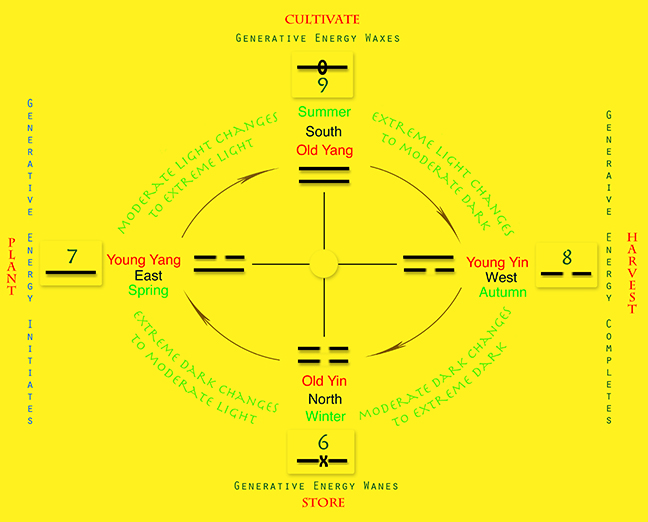
We moderns tend to view time as linear, forgetting that, as one Taoist sage put it, Everything we know about spirit we learn by analogy from nature.  The seasons of the year correspond to the times of day, both of which correlate to the four directions of the compass in what has been termed the Spatializaton Of Time—

The Map of Inner Change

The Map of Inner Change

By analogy, we know that Spring symbolizes the sowing of seeds, that Summer symbolizes the cultivation and care of what we are growing, that Autumn symbolizes the gathering in and harvesting of our efforts, that Winter symbolizes the resting and saving up of energy for the next creative effort.  This is the cyclical aspect of time:  starting something new, nurturing and developing it, sharing the benefit with others, and consolidating resources for the next endeavor.

But the spiritually potent aspect.  That is something else.  It requires that we sensitize ourselves to the Livingness of Space.  It means leaving behind the view of matter as dead and directly experiencing stone and tree and animal and weather and the sun and stars as Alive and Aware, with no less a spiritual half of their body than ours possesses.  It means standing in Spring and feeling the mood and intention of the creative force governing that season.  It requires, in a word, returning to the world view of indigenous people everywhere who hold every thing in creation as sacred persons, each with a lifetime and heart-mind of its own.  It is only our lack of sensitivity to the mood and intention of the creative forces invested in, and emanating out of, each thing that keeps us bound up in isolation and alienation from the loving embrace of Spirit-Nature.

It will seem strange to some to think of a stone as a sacred person.  But then again, have they ever thought of themselves as a sacred person?  They may know that indigenous people ask the plant for permission to take its leaves or ask the stone for permission to carve it but do they understand that the plant or stone are being treated as a sacred person?  One thing we can see as utter fact is the equality with which the universe treats all things:  the eagle may take the hare, but it dies touching the high-voltage wires around its nest, dooming the rabbits offspring as well as its own.  Any hierarchy we imagine to exist is leveled by death and accident.  The electrons making up my body come from stone and tree and sun and stars and, when this body disintegrates, its electrons will fly off into billions of directions to help constitute other persons, many of whom will not be human beings.  The webwork of subatomic particles forming the space-time continuum has no “holes”.  It is simply one unbroken interwoven Livingness of Space.

Every practical person in the world knows that things cannot go on like they have been any longer.  Only blindfolded ideologues and self-serving demagogues continue to push civilization closer and closer to self-destruction.  The rest of us know—or are rapidly coming to recognize—that we cannot simply go on propagating the same old dead worldview that allows the most brutish among us to continue desecrating Nature and Humanity.

The ancient Mayans and their counterparts throughout ancient Mesoamerica—as well as other indigenous peoples around the world, such as the visionaries who constructed the ancient Chinese oracle, the I Ching—were well aware of the patterns of human behavior, both individual and collective.  Intrinsic to such worldviews is the concept of a universal duality that makes up the universal unity of the world.  While this has many cosmological significances in term of the creation and sustaining of the world, it plays itself out in the patterning of human perception and behavior through the rule of action and backlash.

The future, in other words, becomes predictable simply by understanding that sooner or later, everything changes into its opposite.  The art of such predictions lies in being able to recognize when things are getting to be either “too much” or “too little”, states which call forth their opposites.  This requires a sensitivity to the underlying mood and intent of things, which manifests itself as a keen sense of timing.  The greater the historical shifts from one opposite to another, the longer the time frame.

December 21, 2012 marks the end of a 5,128-year cyle.  The Mayan Long Count calendar is established as beginning on a purely mythological date of August 11, 3114 BC in order that its end date would occur in our time.  The Mayan mathematicians went so far as to drop the date directly on a Winter Solstice, just to get our attention.  Aware of the patterns of human perception and behavior, the Mayan priest-scribes foresaw this time, our time, as the one in which the dead worldview would give way to the Living Worldview.

Let us honor their sensitivity to the changing Ages of human nature and their keen sense of timing.

Let us honor our own sacred nature by ending this Dark Age of inhumanity and joyfully advancing in the next, more humane, Golden Age of Humanity.

.

The Toltec I Ching, by Martha Ramirez-Oropeza and William Douglas Horden has just been released by Larson Publications.  It recasts the I Ching in the symbology of the Native Americans of ancient Mexico and includes original illustrations interpreting each of the hexagrams.  Its subtitle, 64 Keys to Inspired Action in the New World hints at its focus on the ethics of the emerging world culture.

2012: Prophesy or Symbol?

October 12th, 2009

Maybe it’s a sign of how dramatically movies drive popular culture but a number of folks deeply steeped in the meaning of the Mayan Calendar and the Mayan writing system—as well as numerous scientists—are coming forward to reassure us that the world is not in actuality coming to an end on December 21, 2012.

By way of example, a Mayan tribal elder is quoted recently as saying that the idea of the calendar predicting a catastrophic doomsday springs from Western ideas and not Mayan.  This has been followed up even more recently by a Washington Post article approaching the matter from a scientific perspective, in which the astronomical basis of the movie 2012 is viewed as sensationalizing for profit.  That article does not take Sony Pictures to task strongly enough for its setting up a phony (and very hi-tech) website called Institute for Human Continuity, whose goal is Ensuring the end is just the beginning and where you can vote for who ought to lead humanity in the post-2012 era.  Sane and caring people everywhere ought to boycott this film just to protest this kind of commercial exploitation.

Think none of this matters?  Think everyone knows its entertainment?

According to the Post article, David Morrison, the author of an online feature called Ask an Astrobiologist, has “gotten nearly 1,000 e-mails from people who think something dire is about to befall the planet. One teenager wrote to Morrison that he’d rather commit suicide than see the world destroyed.”

An even more recent Los Angeles Times article entitled, Scientists try to calm ‘2012′ hysteria, notes:

Morrison says it’s hard to know whether the people who have written to him with their fears represent a fringe or a larger cross-section of Americans who, distrustful of traditional sources of information and the authorities behind them, are falling victim to the Internet’s snake-oil salesmen.

In such an environment, the viral marketing campaign for the movie “2012,” which encourages people to “Vote for the Leader of the Post-2012 World,” can seem like confirmation of the apocalypse, rather than of an upcoming 90-minute entertainment vehicle.

A spokesman for Sony Pictures, Steve Elzer, said: “We believe consumers understand that the advertising is promoting a fictional film.”

Morrison said the movie’s distributors are feeding the “panic” by creating some of the fake science websites. Most of the sites, Morrison said, are full of misinformation and speculation, often by people who have written books they are trying to sell.

But scientific and ethical considerations aside for the moment, let’s return to the source of the 2012 phenomenon, the ending of a 5,128-year cycle of time as marked by the Mayan Calendar.

Drawn away from purely academic writings for the moment, David Stuart, arguably the foremost expert on Mayan glyphs in the world,  spoke his own words of reassurance for informed lay readers, in which he clarified his previous statements regarding the now-famous Monument Six of Tortugero, one of the few surviving Mayan texts that actually seem to predict events—and that specifically mentions the December 21, 2012 date.

Or does it?  Stuart references an article by his colleague Stephen Houston, who points out greater ambiguity in the reading of Monument Six than previously recognized.  The date may not reference any objective date but rather be ceremonial, having to do with the consecration of a particularly sacred building.

Great pains are being taken by such noted experts and the Mayans themselves to point out that the misconceptions about the world ending simply because the Mayan calendar turns over and begins another 5,128-year cycle are based on exaggerations and decidedly Western apocalyptic myth-making.  Why?  Well, obviously, the release of the special effects extravaganza 2012 may push already-anxious men, women and children into fear overdrive.

At Cornell University, Ann Martin, who runs the “Curious? Ask an Astronomer” Web site, says people are scared.
“It’s too bad that we’re getting e-mails from fourth-graders who are saying that they’re too young to die,” Martin said. “We had a mother of two young children who was afraid she wouldn’t live to see them grow up.”

Few people, after all, are well-versed in Mayan calendrics and astronomical cosmology, especially of the type that purports to deal with phenomena that recur only every 26,000 years or so.  Enter the infotainment industry with its conscience-less view on sensationalizing the latest world-ending fad in order to increase revenue.  There is apparently no end of people willing to come forward with their direst interpretations, selectively citing facts that bolster their theories.  The more shocking and attention-getting the better.  And the public good be damned.

A comprehensive and up-to-date review and criticism of the whole gamut of speculations related to the 2012 phenomenon can be found on Wikipedia.  Its clear-eyed evaluation of the phenomenon is augmented with useful research into the history of its ideas and the personalities of its proponents.  Bottom line?  There is nothing to any of the claims of the world ending in 2012.

Likewise, there is a lengthy and very informative article here that discusses the particular difficulties of interpreting specific dates and meanings of Mayan calendrics, especially related to the problem of exactly where the Mayans envisioned their calendar starting over.  This is the rather abstruse but fascinating issue of whether a pictun occurs after 13 baktuns or, as is favored by many specialists, after 20 baktuns.

And so, in that vein, I would like to add my voice to that of responsible folks in the Mayan and academic communities, attempting to inform in a useful and meaningful way.

The date December 21, 2012 falls on a day called 4-Ahau in the Mayan calendar, which corresponds to the day 4-Flower in the similar ritual calendars of the indigenous peoples to the north of the Maya, such as the Mixtecs and Aztecs.  All of these civilizations had a schema of recurring Ages (or Suns) that ended on one of the 20 days of their calendar and was accompanied by the numeric coefficient “4″.  On the famous “Aztec Calendar Stone”, for example, the Ages are seen as ending on the days 4-Jaguar, 4-Wind, 4-Water, 4-Rain, and 4-Movement.  Obviously, each of these Age-ending dates is succeeded in turn by another, new, Age.

The essential point is that these dates commemorate and celebrate the creation of the world.  They are life-affirming, a philosophy of history that takes into account the periodic transformations of civilization, each one better and brighter than the last.

These are symbolic dates, in other words.  Not world-ending events.  World-beginning events.  Metaphorical.  Not literal.  Symbolic.

But we are symbolic creatures, are we not?  To such an extent that the great anthropologist Mircea Eliade called us homo symbolicus.  The use of artifacts as old as 75,000 years points to the origins of language, imagination and spirituality in this creature we call human being.  We have a sea of symbols inside us and we seem predisposed to connect those symbols to people, things, events or ideas that infuse our lives with extra meaning.  Not all meaning needs be positive, however.  Fear can add meaning, even if it increases distress and distrust.  And drama.  Especially if it seems to bind us closer to others.

And as has been noted, we are herding creatures, after all.  Beyond some threshold point, we move and act in a more collective manner than we generally recognize.  Presidential elections, real estate bubbles, groupthink, the list is as long as it is embarrassing.

In the present case, the 2012 phenomenon finds itself in the company of other symbolic world-ending predictions:  the end of the millennium, Y2K, biblical prophesies, Nostradamus, and a host of others that various people interpret as coinciding with this date.  Beyond the purely unethical behavior of using technology and the resources of the media to instill fear in people for profit, we as a culture need to question the wisdom of rewarding those whose use shock for personal gain:  The more shock is used on us, the more inured we become to it, so the more has to be administered in order for us to feel shocked.  Yes, it’s like a drug.  And we ought to know enough by now to stay away in droves from those who peddle it.

We also ought to know by now that human nature possesses a self-defeating, self-destructive side that justifies greed, exploitation, and narcissism.  Is it that we, as individuals, can become so mesmerized by our sense of self-importance that we cannot imagine the world going on after our death?  Is it possible for us to prefer that the whole world end than that it might go on without us?

My take on the 2012 phenomenon is that the facts have become irrelevant.  And maybe that’s a good thing.

There is currently a mood toward anticipating something dramatic happening on the Winter Solstice of 2012 and, even if it amounts to nothing but a self-fulfilling prophecy, this mood is likely to provoke some profound inner changes in those people who take it seriously.  In this sense, it is not so different than contemplating one’s own death:  it brings about a reconsideration of one’s life, how it is being spent, what is really important, what true purpose should be, and so on.  Seriously reflecting on the end of the world has got to impact our inner lives—and perhaps our outer actions.  In this sense, it might not be so different than those who survive a near-death encounter:  It brings about a renewed sense of wonder and reevaluation of what is truly worth preserving.

Perhaps the symbolic end of the world this time around will fuel our collective imagination and inspire our collective heart to renew our desire for a truly benevolent civilization that bequeaths peace and prospering to all our great-grandchildren and their descendants worldwide.

Not the end of the world, then.  But the end of a world view, maybe.

A celebration  of creation-in-the-making.

Perhaps the symbolic end of the Age this time around will convince us that the Golden Age of Humanity is within our reach if we but dare hold out our hand.

.

The Toltec I Ching, by Martha Ramirez-Oropeza and William Douglas Horden has just been released by Larson Publications.  It recasts the I Ching in the symbology of the Native Americans of ancient Mexico and includes original illustrations interpreting each of the hexagrams.  Its subtitle, 64 Keys to Inspired Action in the New World hints at its focus on the ethics of the emerging world culture.

The Untroubled Spirit

October 5th, 2009

Just as continuous pressure inevitably transforms coal into diamond, continuous effort to purify awareness inevitably transforms the troubled spirit into the untroubled spirit—and, just as the change from coal to diamond is permanent and irreversible, so too is the metamorphosis of the troubled spirit into the untroubled spirit.

–Hexagram 45, Casting Off, The Toltec I Ching

45